Fishing Rod Power vs. Action: A Beginner’s Blueprint for Picking the Right Stick
In bass fishing terminology, a rod’s Power and Action are two distinct characteristics that define how it performs. While some manufacturers and anglers use these terms interchangeably, they represent different mechanical properties. Understanding the difference is the key to choosing a rod that matches your fishing style.
If you’re just starting out, see our How to Choose a Bass Fishing Rod guide for a complete overview of rod selection.
In This Guide
- Understanding the Difference: Power vs. Action
- Fishing Rod Power Chart
- Fishing Rod Action Chart
- Key Takeaways for Beginners
- Frequently Asked Questions
- Next Steps for You
Understanding the Difference: Power vs. Action
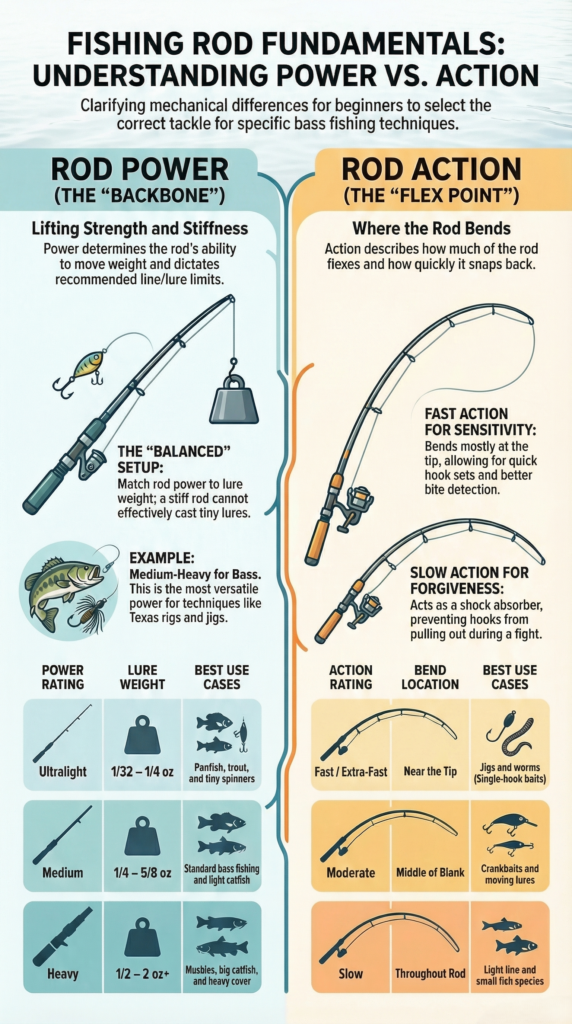
Rod Power refers to the rod’s stiffness or strength and its ability to lift weight. It dictates what line strength and lure weight the rod can handle effectively. Think of power as the rod’s “backbone.”
Rod Action refers to where the rod bends and how quickly it returns to a straight position. A “fast” action bends near the tip, while a “slow” action bends further down the blank. Think of action as the rod’s “personality”—how it loads and unloads during a cast and fight.
For a deeper dive into how these specs affect your fishing, check out our Fishing Rod Power vs. Action Chart with visual examples.
Fishing Rod Power Chart
The following chart outlines common power ratings and their intended “fishing jobs.”
| Power Rating | Recommended Line | Lure Weight | Best Use Cases |
|---|---|---|---|
| Ultralight | 2–6 lb test | 1/32 – 1/4 oz | Panfish (bluegill, perch), small trout, long casts with tiny spinners |
| Light | 4–8 lb test | 1/16 – 1/4 oz | Finesse fishing, stream trout, smallmouth bass in small streams |
| Medium-Light | 6–10 lb test | 1/8 – 1/2 oz | Versatile for beginners; good for walleye, crappie, and average bass |
| Medium | 8–12 lb test | 1/4 – 5/8 oz | The “standard” for bass fishing; lands panfish to bass and light catfish |
| Medium-Heavy | 10–20 lb test | 3/8 – 1 oz | Best for most bass techniques including Texas rigs, jigs, and larger spinnerbaits |
| Heavy | 15–30+ lb test | 1/2 – 2 oz+ | Muskies, big catfish, stripers, and “horsing” big bass out of thick weeds/cover |
Pro Tip: For your first bass rod, choose Medium or Medium-Heavy power. It’s the sweet spot for versatility. See our Best Bass Fishing Rods for Beginners for specific model recommendations.
Fishing Rod Action Chart
The action determines your casting accuracy and how well you can detect bites.
| Action Rating | Where the Rod Bends | Advantages / Best Uses |
|---|---|---|
| Fast / Extra-Fast | Mostly at the tip | Best for sensitivity and quick hook sets with single-hook baits like jigs, Texas rigs, and worms |
| Moderate (Medium) | Near the middle of the blank | Versatile and forgiving; prevents pulling treble hooks out of a fish’s mouth. Ideal for crankbaits, jerkbaits, and topwater lures |
| Slow | Throughout the entire rod to the butt | Specialized for light line and small fish; allows the rod to act as a complete shock absorber. Rarely used for bass |
Pro Tip: For beginners, a Fast action rod is the most versatile choice. It provides the sensitivity to feel bites and the backbone for solid hooksets. Learn more in our How to Choose a Bass Fishing Rod guide.
Key Takeaways for Beginners
1. Balance Is Critical
You must match your rod’s power to the line and lure weight. For instance, a heavy-action rod cannot cast a 1/16 oz lure because the lure isn’t heavy enough to “load” (bend) the stiff rod. Conversely, a light rod paired with a heavy lure risks snapping the blank.
For help matching your rod, reel, and line, see our guide on Balanced Tackle: How to Match Rod, Reel, and Line.
2. Versatility Wins for First Rods
For a first multi-purpose outfit, experts recommend a 6’6″ to 7′ Medium power, Fast action spinning rod. This “middle-of-the-road” setup is sensitive enough for panfish but strong enough to land trophy bass or catfish. Pair it with 8–12 lb monofilament line for the ultimate beginner combo.
3. Durability vs. Sensitivity: Composite Is Your Friend
- Graphite: Lightweight and sensitive, but can be brittle.
- Fiberglass: Nearly unbreakable, but heavier and less sensitive.
- Composite Blends: The best of both worlds. Rods like the Ugly Stik GX2 blend fiberglass for toughness and graphite for sensitivity, creating a durable workhorse that is nearly indestructible.
Read our Ugly Stik GX2 Complete Guide to see why it’s the top choice for beginners who need durability.
Frequently Asked Questions
Q: Can I use a medium-heavy rod for finesse fishing?
You can, but it’s not ideal. Medium-heavy rods are stiffer, making it harder to feel subtle bites and cast light lures. For finesse techniques like drop shot or Ned rig, a medium-light or medium rod with fast action is better. See our Finesse Fishing Guide for details.
Q: What’s the difference between power and action in simple terms?
Power = Stiffness. How much weight the rod can lift.
Action = Bend point. Where the rod flexes and how quickly it recovers.
Q: What rod action is best for crankbaits?
Moderate or Moderate-Fast action. The slower bend absorbs the head shakes of a fish, keeping treble hooks pinned. Fast action rods can rip the hooks out. Learn more in our Crankbait Rod Selection Guide.
Q: Do I need a different rod for spinnerbaits vs. Texas rigs?
Not necessarily. Both work well on a Medium-Heavy, Fast action rod. It provides the backbone for solid hooksets and the power to pull fish out of cover. For a full breakdown, see our Technique Match Chart.
Next Steps for You
Now that you understand power and action, here’s what to do next:
- 🎣 How to Choose a Bass Fishing Rod – Complete beginner’s guide to rod selection
- 📊 Best Bass Fishing Rods for Beginners (2026 Top Picks) – Specific model recommendations
- 🧵 Fishing Line for Beginners – Match your line to your rod’s power
- 🐟 Best Bass Lures for Beginners – What to tie on based on your rod’s action
- 📘 Bass Fishing for Beginners: Complete Start-Up Guide – Everything you need to know