Seasonal Bass Behavior 2026: Where Largemouth, Smallmouth, and Spotted Bass Hide (Beginner Guide)
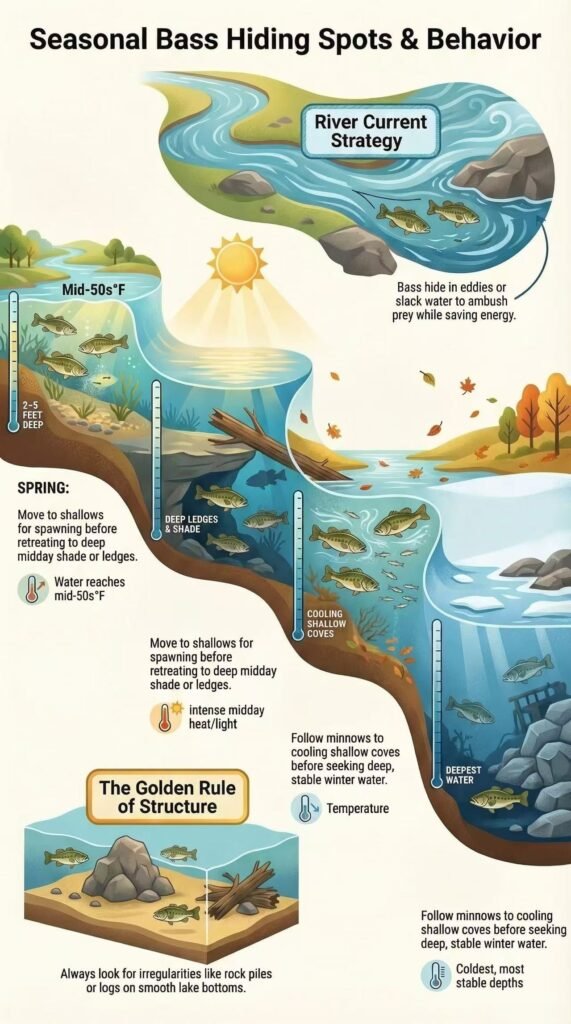
To consistently catch black bass—whether the plentiful largemouth, current-loving smallmouth, or the adaptable spotted bass—beginners must understand one key fact: these fish are creatures of habit and survival. They don’t wander randomly. Instead, they position themselves around structure (any irregularity on an otherwise smooth bottom, like rocks, logs, drop-offs, weeds, or docks) and cover (shade, vegetation, or objects that provide safety and ambush points). Their locations shift dramatically with the seasons, driven primarily by water temperature, oxygen levels, metabolism, and food availability.
New to bass fishing? Start with our Bass Fishing for Beginners: Complete Start-Up Guide to learn the basics before diving into gear.
Mastering these patterns turns a slow day into a productive one. Here’s a clear breakdown for 2026, based on proven seasonal cycles.
Spring: The Shallow Migration & Spawn
As winter ends and water temperatures rise from the mid-50°F range, bass experience a physiological boost. They feed aggressively to build energy for spawning.
- Pre-spawn (mid-50s to low-60s°F): Bass transition from deep winter holes to warming shallows.
- Spawn (60–65°F peak, up to 70°F): Largemouth prefer protected shallows (2–5 feet) in wind-sheltered coves, backs of embayments, or quiet flats. Smallmouth and spotted bass often nest on main-lake shorelines, gravel flats, or near single rocks, stumps, or logs.
- Post-spawn: Bass linger in shallows for weeks, holding near points (ridges extending into water) to ambush baitfish.
Best hiding spots: Shallow cover like submerged logs, stumps, emerging weeds, or points with access to deeper water.
Summer: Beating the Heat & Seeking Comfort
High surface temperatures (>80°F) increase metabolism but reduce oxygen in shallows, pushing bass deeper or into shade.
- During peak heat and bright daylight, they hide in thick cover: lily pads, dense weedbeds, boat docks, or overhanging trees.
- In reservoirs, look for schools along underwater ledges, channel drop-offs, sunken roadbeds, or humps.
- Low-light periods (dawn, dusk, night, or cloudy days) bring them shallow again for feeding when water cools and they feel safer.
Best hiding spots: Deep shade, vertical structure (ledges/drop-offs), or heavy vegetation; focus on areas with stable oxygen like springs.
Fall: The Aggressive Feeding Frenzy
Cooling air and dropping water temps (starting in shallows) signal preparation for winter, drawing baitfish—and bass—back shallow.
- Bass turn highly aggressive, chasing migrating minnow schools.
- Prime spots: Back ends of major bays, feeder creeks emptying into main water, shorelines, and points where bait concentrates.
Best hiding spots: Shallow to mid-depth cover near bait (creek mouths, vegetation edges, rocky points); fall is often the most consistent season for bites.
Winter: The Deep, Low-Activity Slumber
Cold water slows metabolism dramatically (cold-blooded fish need less food). Bass become inactive and conserve energy.
- They move to the deepest, most stable water (often 20–50+ feet in reservoirs).
- Hold near bottom structure like deep channels, ledges, timber, or rock piles until spring warming restarts the cycle.
Best hiding spots: Deep drop-offs, channel edges, humps, or submerged timber; target vertical structure for quick access to potential food.
Hiding in Rivers and Streams (Flowing Water Bonus)
Current dictates location—bass avoid wasting energy fighting strong flow, acting like “underwater accountants” by holding in low-effort zones.
Common spots:
- Current breaks: Eddies behind large rocks, root wads, fallen trees, or bridge pilings (slack water pockets).
- Undercut banks: Deep, shaded shore cuts shielded from flow.
- Tailwaters: Below dams, where oxygenated water attracts congregations.
- Flooded lowlands: During high water, bass move into temporary flooded fields/woods for easy prey.
Tip for Quebec anglers: In rivers like the St. Lawrence or Ottawa, focus on eddies and current seams year-round—smallmouth especially love rocky breaks in cooler months.
The Golden Rule: Think Like a Bass
No matter the season, success comes from spotting irregularities—a lone rock pile on a flat, a submerged log in open water, or a weed edge on a drop-off. These provide comfort (stable temp/oxygen), safety (cover from predators), and food access (ambush points).
Look for structure + cover + bait proximity. Use electronics or polarized sunglasses to spot them, then target with your Ugly Stik GX2 (perfect for pulling fish from cover!).
Ready to apply this? Check our Ugly Stik GX2 Review 2026 .
Ready to Start? Here’s What to Do Next
- 🎣 Choose Your First Rod – Best beginner rods reviewed
- 🐟 Pick Your First Lures – Simple picks that catch fish
- 🔄 Spinning vs. Baitcaster – Which reel is right for you?
- 🧵 Spool Your Reel Correctly – Step-by-step guide
- 📍 Find a Fishing Spot – Bank fishing tips for beginners
← Back to: Bass Fishing for Beginners: Complete Start-Up Guide (2026)!
← Back to: Bass Fishing for Beginner Hub!
