Texas Rig Setup: Step-by-Step Guide for Bass Fishing Beginners
The Texas rig is a versatile, weedless setup designed to help you fish through heavy cover like grass, timber, and rocks without snagging. It is widely considered one of the most effective bass fishing techniques for beginners and pros alike. Following this step-by-step guide will help you set it up correctly and start catching fish.
If you’re new to bass fishing, start with our Bass Fishing for Beginners: Complete Start-Up Guide for an overview of all the gear you’ll need.
Table of Contents
Gather Your Tackle
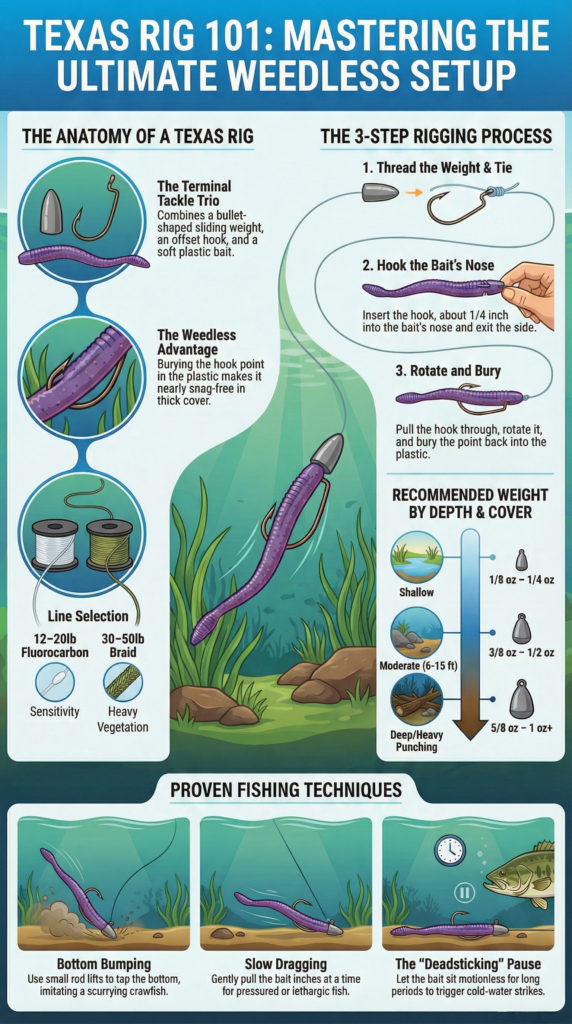
To build a Texas rig, you will need the following components:
Beginner Tip: Start with a 3/0 or 4/0 EWG hook, a 1/4 oz bullet weight, and a 6-inch plastic worm. This combination works in most fishing situations.
For help choosing the right soft plastics, see our Best Bass Lures for Beginners guide.
Assemble the Rig on Your Line
Follow these three steps to assemble the Texas rig correctly.
| Component | Recommended Type | Why It Matters |
|---|---|---|
| Hook | Offset worm hook (for slim baits) or EWG hook (for bulky creature baits) | EWG hooks provide better gap for thicker baits |
| Weight | Bullet-shaped slip sinker (tungsten preferred) | Tungsten is smaller, denser, and more sensitive than lead |
| Soft Plastic Bait | Worms, craws, or creature baits | 4–7 inch worms are the most beginner-friendly |
| Optional | Glass or plastic bead | Adds clicking sound and protects your knot |
Step 1: Slide on the weight
Thread your fishing line through the pointed end of the bullet weight so the base of the weight faces the hook. The pointed end should face the rod tip, and the flat base should sit against the hook.
Step 2: Add a bead (Optional)
Slide an optional glass or plastic bead onto the line after the weight. The bead serves two purposes: it creates a clicking sound when it hits the weight, and it protects your knot from the weight’s impact.
Step 3: Tie the hook
Use a strong knot to secure your hook to the line. The Palomar knot is the strongest and easiest for beginners. The Improved Clinch knot is also reliable. See our Easiest Fishing Knot for Beginners guide for step-by-step instructions.
Pro Tip: Wet your knot before tightening it. This reduces friction and prevents line damage.
Rig the Soft Plastic Bait
This is the most critical part of the Texas rig. A properly rigged bait will hang straight and stay weedless.
Step 1: Thread the nose
Take the point of the hook and pierce the center of the bait’s “nose.” Push it down about 1/8 to 1/4 inch (roughly half a centimeter). Do not push it all the way to the hook eye yet.
Step 2: Exit the side
Poke the hook point out the side of the bait and pull the entire hook through until the eye of the hook is at the bait’s nose. The hook should now be embedded lengthwise in the bait.
Step 3: Rotate the hook
Twist the hook 180 degrees so the point is facing back toward the body of the bait. This rotation is what makes the bait ride straight.
Step 4: Bury the point (The Weedless Step)
Lay the hook against the side of the bait to see where the bend naturally meets the plastic. Poke the hook point straight through the bait at that spot so the bait hangs perfectly straight.
Step 5: Skin-hook the tip
To make it truly weedless, slightly bury the very tip of the hook point back into the surface of the plastic. This is often called “Tex-posing” — the point is hidden in the plastic’s skin, keeping it from catching on debris, but will easily penetrate a fish’s mouth on the hookset.
Common Mistake: Rigging the bait crooked or twisted. The bait should hang perfectly straight along the hook shank. If it twists, redo Step 3.
Pro Tips for Success
Match weight to depth and cover
| Water Condition | Recommended Weight | Why |
|---|---|---|
| Shallow water (1–5 ft) or natural fall | 1/8 – 1/4 oz | Allows bait to sink slowly and naturally |
| Moderate depth (5–10 ft) or light weeds | 3/8 – 1/2 oz | Gets bait down faster while maintaining feel |
| Deep water or thick vegetation | 5/8 – 1 oz+ | “Punches” through heavy mats to reach bass below |
Choose the right line
- Fluorocarbon (10–17 lb): The most popular choice for Texas rigs. It is nearly invisible underwater, has low stretch for sensitivity, and is abrasion-resistant.
- Braid (30–50 lb): Use when fishing in extremely thick mats, grass, or around heavy cover. Braid has no stretch, providing maximum hooksetting power.
For a complete breakdown, see our Fishing Line for Beginners guide.
Don’t overwork the bait
One of the most common mistakes is moving the rig too fast. Use slow, deliberate rod lifts or “drags” to let the bass find the bait. A typical retrieve: lift the rod tip slowly, let the bait fall back down on a slack line, then take up the slack and repeat. Most strikes happen on the fall.
For more on bass behavior and strike detection, see our How Bass Sense and React to Lures guide.
Frequently Asked Questions
What is the best hook size for a Texas rig?
A 3/0 or 4/0 EWG hook works for most 4–7 inch soft plastics. Use larger hooks (5/0–6/0) for bigger baits like 10-inch worms or large creature baits.
Do I need a bead on my Texas rig?
No, but it helps. The bead creates a clicking sound that can attract bass and protects your knot from the weight’s impact. Many beginners skip it without issue.
Can I fish a Texas rig on a spinning rod?
Yes. A medium or medium-heavy spinning rod with 10–17 lb fluorocarbon works perfectly. For heavy cover, a baitcasting rod with braid is better. See our How to Choose a Bass Fishing Rod guide.
How do I know when a bass bites my Texas rig?
Watch your line. When the bait falls on slack line, a bite often appears as a sudden twitch, stop, or sideways movement of the line. Set the hook when you feel weight or see the line move abnormally.
What rod action is best for Texas rigs?
Fast action. It provides the sensitivity to feel bottom composition and the backbone for a solid hookset through the weed guard. See our Fishing Rod Power vs. Action guide.
Next Steps for You
Now that you know how to tie a Texas rig, here’s what to do next:
- 🎣 How to Choose a Bass Fishing Rod – Match your rod to this technique
- 🧵 Fishing Line for Beginners – Pick the right line for Texas rigging
- 🐟 Best Bass Lures for Beginners – More soft plastic options to try
- 📘 Bass Fishing for Beginners: Complete Start-Up Guide – Everything you need to know
The Texas rig is a “bass killer” for a reason. Master this setup, and you’ll be prepared to fish almost any cover, from weedy lakes to rocky riverbeds. Practice the steps above, focus on slow, deliberate presentations, and the fish will follow.
← Back to: Bass Fishing for Beginners: Complete Start-Up Guide (2026)!
← Back to: Bass Fishing for Beginner Hub!