10 Beginner Fishing Mistakes You Must Avoid in 2026
Fishing is a skill built on smart habits, not just luck. Most beginners catch far fewer fish—and get far more frustrated—because they repeat the same preventable mistakes. This pillar guide highlights the top 10 beginner fishing mistakes (with a strong focus on bass but applicable to most freshwater species) and gives you clear, actionable fixes to boost your catch rate, reduce lost time, and make every trip more enjoyable.
Master these fundamentals early, and you’ll progress much faster than anglers who learn the hard way.
1. Rigging Soft Plastics Crookedly
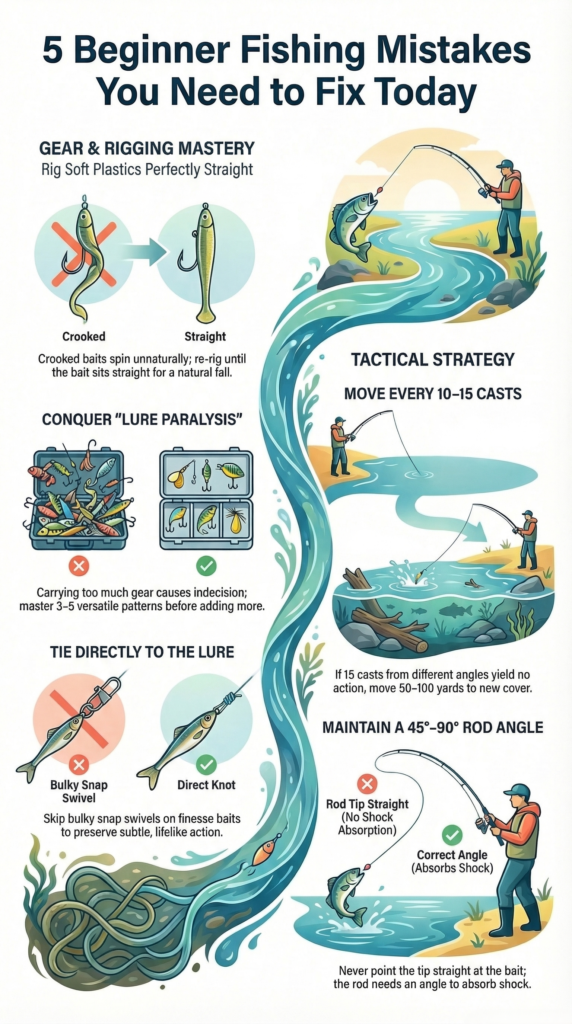
A wacky-rigged worm, Texas-rigged creature, or drop-shot bait that swims sideways or spins unnaturally is one of the fastest ways to kill bites. Bass detect the unnatural action instantly and often refuse it, plus it creates line twist and tangles.
Fix: Always take a quick look down the line after rigging. If there’s any kink or curve, re-rig until it’s perfectly straight. A straight presentation lets the bait fall and swim naturally—huge difference in bites.
2. Staying in One Spot Too Long (or Abandoning Too Quickly)
New anglers either stick in a dead spot all day hoping fish “show up,” or give up after just a few casts on a potentially good area. Fish concentrate in specific cover and structure—90% of them in 10% of the water.
Fix: Make 10–15 quality casts from different angles. No action? Move 50–100 yards to new cover (weeds, laydowns, points, docks). Keep moving until you find active fish.
3. Tackle Overload & “Lure Paralysis”
The tackle industry pushes endless “must-have” lures, leading beginners to carry way too much gear. This causes “lure locking”—spending more time digging through boxes and switching baits than actually fishing.
Fix: Start with 3–5 truly versatile patterns and master them: weightless Senko or wacky worm, paddletail swimbait, Ned rig, Texas-rigged creature bait, and a spinnerbait or crankbait. Add more only after consistent success.
4. Pointing the Rod Tip Straight at Your Lure
Keeping the rod tip low and pointed directly at the bait eliminates the rod’s ability to act as a shock absorber. When a big fish strikes hard, the line often snaps or the hook pulls free.
Fix: Maintain a 45–90° angle between rod tip and line at all times. This lets the rod flex and absorb the shock of explosive strikes and headshakes.
5. Over-Reliance on Snap Swivels
Snap swivels are convenient for quick lure changes, but they add bulk, disrupt subtle lure action, and can cause spinning—especially deadly on finesse presentations like Ned rigs or wacky worms.
Fix: Tie direct to the lure using a strong, reliable knot (Palomar or Improved Clinch recommended). Reserve small snaps (no swivel) only for treble-hook moving baits like crankbaits.
6. Neglecting Line & Hook Maintenance
Nicked line from rocks or wood, dull hooks from snags, or ignored reel issues are silent fish-killers. A tiny flaw can cost you the fish of a lifetime.
Fix: Before and after every trip: run your fingers over the last 10–20 feet of line and re-tie at any abrasion. Sharpen or replace hooks. Clean and lightly oil your reel. Store line out of direct sun.
7. Fishing “History” Instead of Current Conditions
Returning to a spot just because you caught fish there last week (or last year) ignores daily changes in water temperature, wind, barometric pressure, bait position, and fish mood.
Fix: Fish the conditions of the day. Check water temp, wind direction, cloud cover, and recent weather patterns. Adapt lure choice and retrieve speed accordingly—slow down after cold fronts, speed up on warm, windy days.
8. Avoiding Thick Cover Out of Fear of Snags
Beginners often cast only to open water because they’re scared of losing lures in weeds, lily pads, fallen trees, or docks. Unfortunately, that’s exactly where most ambush predators (especially bass) live.
Fix: Use weedless rigs (Texas, wacky weedless, frog, punch rig) and cast confidently into and around cover. Accept occasional snags—it’s the price of fishing where the fish actually are.
9. Incorrect Hook Set Timing & Force
Setting the hook the instant you feel a tap often rips the bait away before the fish fully eats it. Conversely, using a violent rip on finesse lures can bend hooks or tear the bait free.
Fix: Wait for solid “weight” or line movement (count 2–3 Mississippi on soft plastics). Use a sweeping set for treble-hook lures, a sharp but controlled snap for jigs/Ned rigs, and a hard, upward set for heavy cover frogs.
10. Small Technical Handling Errors
A few tiny mistakes compound into big problems:
- Closing the spinning reel bail by turning the handle → creates line loops and wind knots.
- Using the ceramic ring of a rod guide as a hook keeper → chips the guide and can cut line later.
- Incorrect drag settings or mismatched line strength.
Fix: Always flip the bail closed by hand. Use the built-in hook keeper or rod butt. Set drag to roughly 1/3 of your line’s breaking strength. Match line to your rod/lure (e.g., 10–15 lb fluoro for finesse, 20–50 lb braid + leader for heavy cover).
Quick Reference Table: Top 10 Mistakes & Instant Fixes
| # | Mistake | Why It Hurts You | Fast Fix |
|---|---|---|---|
| 1 | Crooked soft plastics | Unnatural action, line twist | Re-rig straight every time |
| 2 | Wrong time in one spot | Miss active fish | Move after 10–15 casts |
| 3 | Tackle overload | Wasted time switching lures | Master 3–5 versatile baits |
| 4 | Rod tip pointed at lure | Line snaps on strike | Keep 45–90° angle |
| 5 | Overusing snap swivels | Kills subtle action | Tie direct (Palomar knot) |
| 6 | No gear/line maintenance | Lost fish to weak line/hooks | Check line & hooks before/after trips |
| 7 | Fishing history | Ignores daily changes | Adapt to current conditions |
| 8 | Avoiding cover | Casting in empty water | Fish weedless into structure |
| 9 | Wrong hook set timing/force | Pull-outs or misses | Wait for weight + match force |
| 10 | Technical blunders | Tangles, breaks, line cuts | Hand-flip bail, proper drag, no guide hook keeper |
Final Thoughts
Avoid these 10 common beginner fishing mistakes, and you’ll catch more fish, lose less gear, and enjoy the water far more. Focus on fundamentals—presentation, movement, observation, and maintenance—before chasing advanced techniques or expensive gear.
Which of these mistakes has cost you the most fish so far? Share in the comments below, and check our other beginner guides for more tips on lure selection, knots, and seasonal strategies!
- 📚 [Fishing Tips] — Fishing Tips for beginners.
- 📚 [Master the Basics] — Step-by-step for beginners.
- 🎣 [Choose Best Gear] — Expert reviews & top picks.
- 🐟 [Catch More Bass] — Pro tactics and spots.
- 🎣 [Back to Bass Fishing for Beginner Hub]