The Beginner’s Guide to Fishing Line and Lures
Success in angling is not a matter of random chance; it is a discipline of skill best summarized by the formula: Right Bait + Right Place + Right Time = Fish (B+P+T=F). While your rod and reel are the levers of the sport, the fishing line and the bait are the most critical points of contact between you and the fish. Understanding these tools allows you to move from “point zero” to a repeatable level of proficiency.
Fishing Line: The Essential Link
Fishing line is the actual link between the angler and the fish, and it must be part of a balanced tackle system. This means matching the line’s strength (pound test) to the rod’s action and the reel’s size to ensure efficient casting and fish playing.
- Monofilament: This single-strand nylon line is the most popular choice for beginners because it is relatively inexpensive, easy to handle, and abrasion-resistant. Its primary advantage is stretch, which acts as a shock absorber when a fish strikes or jumps, preventing the hook from tearing out.
- Superlines (Braid): Made of multiple gel-spun polyethylene fibers, superlines are much stronger than monofilament of the same diameter. They have almost no stretch, providing extreme sensitivity to feel even the lightest “taps” from a fish. However, they are more expensive and visible in clear water.
- Fluorocarbon: This line is denser and heavier than nylon, helping lures sink faster. Its refractive index is nearly identical to water, making it virtually invisible to fish, which is a major advantage in clear-water conditions.
- Maintenance: Monofilament ages and is weakened by heat and direct sunlight. Experts recommend replacing your line twice a year and frequently checking for nicks or rough spots by running the last few feet of line between your thumb and forefinger.
New to bass fishing? Start with our Bass Fishing for Beginners: Complete Start-Up Guide to learn the basics before diving into gear.
The Choice: Natural Bait vs. Artificial Lures
Anglers must decide between organic natural baits and engineered artificial lures based on convenience and fish behavior.
1. Natural Bait: The Real Deal
Fish generally prefer natural bait over artificials because it offers a real look, movement, and smell.
- Worms: Nightcrawlers and “wigglers” are the most popular baits for everything from panfish to bass.
- Minnows: Live minnows (shiners, fatheads, or goldfish) are highly effective for predators like crappie and bass.
- Crayfish: A “holy grail” for bass, crayfish are particularly effective when bounced along rocky bottoms.
Artificial Lures: Triggering the Strike
Artificial lures are designed to mimic natural prey or irritate fish into an aggressive “reaction strike” through noise, vibration, and movement.
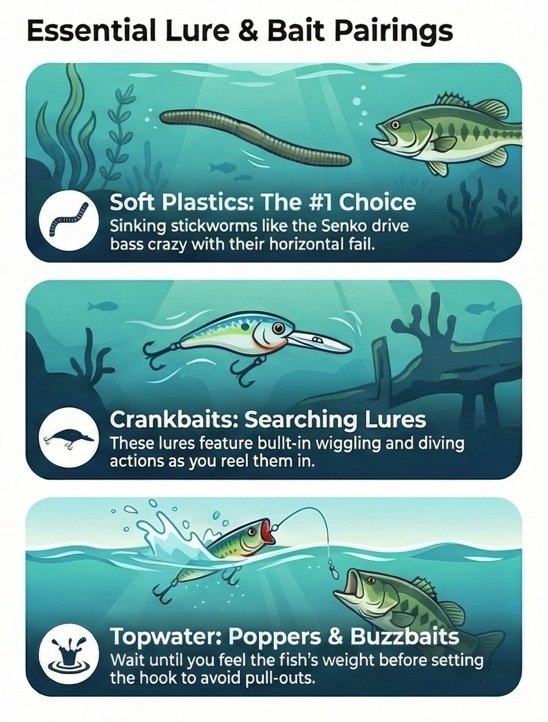
- Soft Plastics: These are highly versatile and often mimic worms, lizards, or crawfish.
- Plastic Worms: Considered the number-one producer of big bass, they are often used with a Texas Rig to be weedless in thick cover.
- Stickworms (Senkos): These are famous for a “do nothing” horizontal fall that drives fish crazy.
- Drop Shot Rigs: Used to suspend a smaller soft plastic bait just off the bottom at eye level.
- Crankbaits: These dive and wiggle automatically when reeled in. They are effective for covering large areas of water quickly. Chartreuse is often recommended for murky water, while natural colors work better in clear water.
- Topwaters: These float on the surface to trigger predatory responses through disturbances.
- Poppers/Chuggers: Make a “bloop” or splashing sound when jerked.
- Buzzbaits: Feature revolving blades that “boil” the water surface.
- Walking-the-Dog: A technique for stickbaits that causes them to zigzag like injured prey.
- Jigs: Often called a “universal bait,” the leadhead jig can be “dressed” with skirts or live bait to catch almost any freshwater fish. They are particularly effective when hopped or bounced along the bottom.
The Strategy of Scent and Color
Understanding how bass use their senses can help you select the right details for your lure.
- Scents: Many soft plastics are impregnated with salt, garlic, or anise. While these don’t necessarily “attract” fish from afar, they cause bass to hold onto a bait longer—sometimes for 30 seconds compared to 2 or 3 seconds—giving you more time to set the hook.
- Color Selection: A fundamental rule is to “match the hatch” by imitating the colors of local forage. In muddy or off-color water, use bright colors like chartreuse or chrome to help fish locate the lure. In clear water, use natural or translucent colors that don’t spook the fish.
By carefully selecting your line and bait and ensuring your tackle is balanced, you stack the odds in your favor and move closer to landing your first “monster of the imagination”.
How to select your fishing rod? please read our professional review.
Fishing Basics
New to the water? Check out our [Fishing Basics Hub] for a complete step-by-step roadmap.
← Back to: Bass Fishing for Beginners: Complete Start-Up Guide (2026)!
← Back to: Bass Fishing for Beginner Hub!